

Social media content strategy mistakes can derail even the most ambitious marketing plans. Social media stands as one of the most powerful brand-building tools today, yet many businesses fail to create engaging posts. The numbers tell an interesting story – employee shares get 8x more engagement than company posts, while brands keep wondering why their carefully crafted content doesn’t perform well.
Every marketer knows the struggle – we post consistently because algorithms reward visibility, and still don’t see the desired results. Posting more often won’t help if your content lacks value. Our experience helping businesses improve their content strategy has revealed several critical mistakes that hurt brand performance. Poor planning and platform-agnostic posting don’t just waste resources – they actively harm your brand’s image.
This piece breaks down the most serious content mistakes companies make on social media and offers clear solutions to revolutionize your approach. Good content does more than generate views – it creates meaningful conversations that build lasting relationships with your audience.
Mistake 1: Skipping the Strategy Phase
Most brands start creating content without a roadmap. Picture building a house without a blueprint. This common mistake of skipping the strategy phase happens more than you’d expect. Research shows 97% of businesses use content marketing. Yet only 57% have documented their strategy, and a mere 19% would call their approach advanced [1].
Why content strategy for business is essential
Content strategy forms the foundation of all marketing efforts. This isn’t just another document—it serves as the backbone of everything you publish. Research reveals that 78% of businesses with “very successful” content marketing had their strategy documented [1]. Companies without clear direction waste resources by creating pointless content that fails both users and the organization [2].
Your content strategy works like a general commanding troops. It shapes decisions about creation, publication channels, and the purpose behind each piece. On top of that, a documented strategy helps teams set priorities and handle random requests that could throw schedules off track [3].
Lining up content with business goals
A content strategy’s key advantage lies in matching your business objectives. Content that doesn’t line up with these goals exists in isolation, cut off from what pushes your company forward.
Your strategy should spell out how content supports specific business goals—from boosting brand awareness to generating leads or building intellectual influence [4]. This connection will give each published piece a real purpose instead of just filling space in your content calendar.
A smart strategy tackles both business and brand results: business outcomes affect sales and profits directly, while brand outcomes shape perception [5]. Well-aligned content delivers measurable ROI—it costs 62% less than traditional advertising [1].
Common planning pitfalls
Brands often fall into several traps when creating their strategy:

A well-crafted content strategy brings laser focus by determining what to do and what to avoid [6]. Skip this crucial phase at your own risk.
Mistake 2: Creating Content That Lacks Value
Businesses face their biggest challenge in creating valuable content. Many brands still struggle to produce content that appeals to audiences, even with solid strategies. Marketing teams invest heavily in content – about 70% of them. Yet much of their material fails to get their target audience to participate [8].
Understanding your audience’s needs
You need to know who you’re writing for to create quality content. Your content will miss its mark without a deep understanding of your audience’s priorities, problems, and interests. You must shape your message to address their specific challenges instead of just promoting products [9].
Start by creating detailed audience personas based on demographics, psychographics, and behavior patterns. Research thoroughly through surveys, analytics, and competitor analysis to learn about your audience [10]. This strategy helps you create content that directly addresses your audience’s concerns and makes it more likely to appeal and connect.
Avoiding content writing mistakes
Your content effectiveness can suffer from these common writing mistakes:
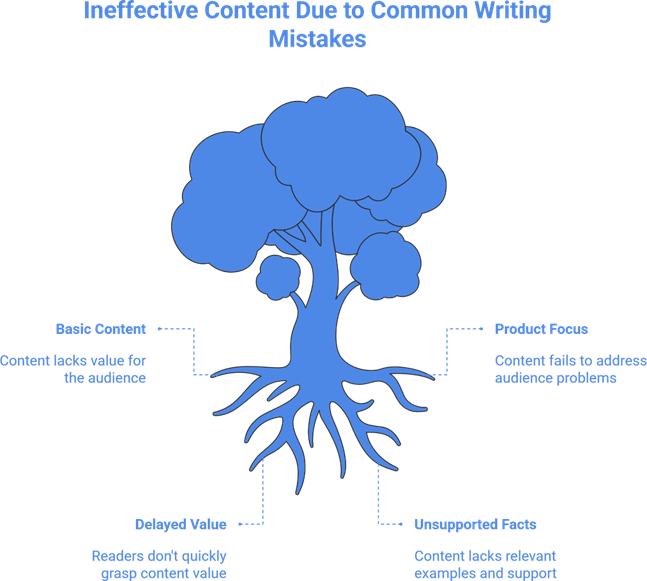
Remember to ask yourself “so what?” as you write content. This simple check will give a clear picture of the value you’re providing instead of just presenting information [12].
Balancing quality and quantity
Quality versus quantity needs careful thought. About 76% of marketers say quality matters more than quantity in their content strategy, though both play important roles [8].
Create fewer but high-quality pieces that offer real value instead of producing lots of average content. This approach builds credibility and authority while attracting better leads that convert more often [13].
Quality content shows your expertise, meets specific audience goals, and gives readers a satisfying experience [14]. A good balance of consistency and quality helps keep your audience interested without compromising content integrity [15].
Mistake 3: Not Tailoring Content to Each Platform
Sharing the same content on every social media platform is like wearing a tuxedo to the beach. Each platform has its own unique environment, and content that works on one platform often fails on another. Your carefully planned content strategy can fall apart with this one-size-fits-all approach.
Why one-size-fits-all doesn’t work
Social media platforms have evolved their own distinct cultures and audience expectations. People on Instagram look for visual appeal and authenticity. LinkedIn users want business insights, and X (formerly Twitter) users prefer quick information bites [2].
Each platform runs on different algorithms that show content to users in unique ways [1]. What gets great results on Instagram might not work at all on X because of these algorithm differences. Your audience might follow you on multiple platforms, and seeing the same content over and over can make them tune out [1].
Platform-specific content strategy methods
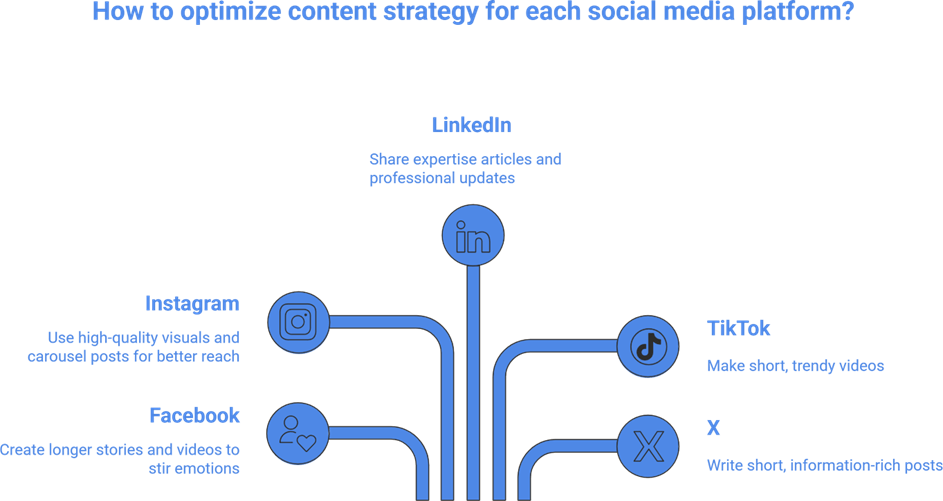
The quickest way to tailor content starts with knowing platform demographics. Facebook reaches more diverse users than any other platform. Instagram and TikTok draw younger audiences [16]. LinkedIn creates a professional space where educational content works best [17].
To get better results:
Examples of optimized vs. generic posts
A product launch announcement needs different approaches. LinkedIn users respond well to detailed PDF carousels about business benefits. Instagram needs eye-catching carousels or Reels. TikTok works better with short, trendy videos, while X needs a quick thread highlighting key points [2].
Brands like Nike show how this works. They create unique content for each platform while keeping their brand message consistent [4].
Mistake 4: Failing to Engage With Your Audience
Great content won’t work if brands make the biggest mistake in digital marketing: posting and disappearing. This behavior kills the social nature of your platforms and ruins your content strategy.
The cost of ‘post and ghost’
“Post and ghost”—publishing content then disappearing—hurts your visibility and relationships badly. Your brand’s failure to respond will push 73% of social users to buy from competitors [20]. On top of that, it reduces your content’s reach when algorithms notice your inactivity [21].
How to build real conversations
You need a consistent presence to create authentic connections. Take 30 focused minutes each day to reply to comments, ask questions, and join relevant discussions [21]. Note that a simple “Thanks so much!” shows you value your audience’s input. Quick responses build credibility and tell platforms you’re an active, valuable user [22].
Encouraging user-generated content
User-generated content (UGC) turns your customers into your most trusted advocates [20]. In fact, UGC affects 79% of consumers’ buying decisions by a lot [23]. Build a community where people feel valued and recognized before you ask them to create content.
Want more insider tips on avoiding common content strategy mistakes? Subscribe to my newsletter for weekly updates on building meaningful connections with your audience.
Key Takeaways
These insights reveal why most brand content fails to generate meaningful engagement and provide actionable solutions to transform your social media strategy.
• Document your content strategy first – 78% of successful brands have written strategies, while most failures skip this crucial planning phase entirely.
• Create value-driven content over promotional posts – Focus on solving audience problems rather than pushing products; quality beats quantity every time.
• Tailor content specifically for each platform – Instagram needs visuals, LinkedIn wants professional insights, and TikTok demands trend-aligned videos.
• Engage actively after posting – “Post and ghost” kills reach and relationships; spend 30 minutes daily responding to build real conversations.
• Encourage user-generated content – 79% of consumers trust UGC more than brand content, making customers your most credible advocates.
Remember: effective content strategy isn’t about posting more—it’s about creating meaningful connections that drive business results. When you align strategy with audience needs and maintain consistent engagement, your content transforms from noise into a powerful relationship-building tool.
FAQs
Q1. How important is having a documented content strategy? A documented content strategy is crucial for successful content marketing. Research shows that 78% of businesses reporting “very successful” content marketing had a documented strategy. It helps align content with business goals, prioritize tasks, and ensure every piece of content serves a purpose.
Q2. What’s the best approach to creating valuable content? To create valuable content, focus on understanding your audience’s needs, preferences, and pain points. Develop detailed audience personas, conduct thorough research, and tailor your messaging to address specific challenges rather than just promoting products. Always ask yourself “so what?” to ensure you’re explaining the value in what you’re writing.
Q3. Why shouldn’t I post the same content across all social media platforms? Each social media platform has its own unique culture, audience expectations, and algorithms. What works well on one platform may not be effective on another. Tailoring content for each platform ensures better engagement and prevents your audience from seeing repetitive content across multiple channels.
Q4. How often should I engage with my audience on social media? Consistent engagement is key. Aim to spend at least 30 focused minutes daily responding to comments, asking questions, and participating in relevant discussions. Prompt responses build credibility and signal to platforms that you’re an active, valuable user, which can improve your content’s visibility.
Q5. What role does user-generated content play in a content strategy? User-generated content (UGC) is extremely valuable, as 79% of consumers report that it significantly influences their purchasing decisions. UGC transforms customers into credible brand advocates. To encourage UGC, focus on building a community where followers feel valued and recognized before asking them to create content.
References
[3] – https://curata.com/blog/integrated-content-strategy/
[4] – https://aicontentfy.com/en/blog/importance-of-customizing-content-for-specific-platforms
[6] – https://www.thinklikeapublisher.com/these-are-the-5-most-common-mistakes-in-your-content-strategy/
[7] – https://www.columnfivemedia.com/how-to-fix-15-content-strategy-mistakes/
[8] – https://nytlicensing.com/latest/methods/achieve-quality-content-marketing/
[9] – https://community.hubspot.com/t5/Content-Marketing/understanding-the-audience/m-p/940563
[11] – https://www.wordtune.com/blog/content-writing-mistakes
[12] – https://www.prizecontent.com/blog/10-mistakes-to-avoid-when-writing-content
[13] – https://farotech.com/blog/quality-content-vs-quantity-in-modern-marketing/
[14] – https://developers.google.com/search/docs/fundamentals/creating-helpful-content
[16] – https://ironmarkusa.com/utilize-social-platforms/
[17] – https://blog.hootsuite.com/social-media-optimization/
[19] – https://sproutsocial.com/insights/what-to-post-on-each-social-media-platform/
[20] – https://sproutsocial.com/insights/user-generated-content-guide/
[22] – https://www.shopify.com/blog/audience-engagement
[23] –https://www.teleprompter.com/blog/how-to-get-more-user-generated-content
 Clear Peak Marketing
Leave a comment